November 11, 2026 · By Chris Floersch
Laguna Seca, 1983: What the Monterey Historic Races Were Like Forty-Three Years Ago
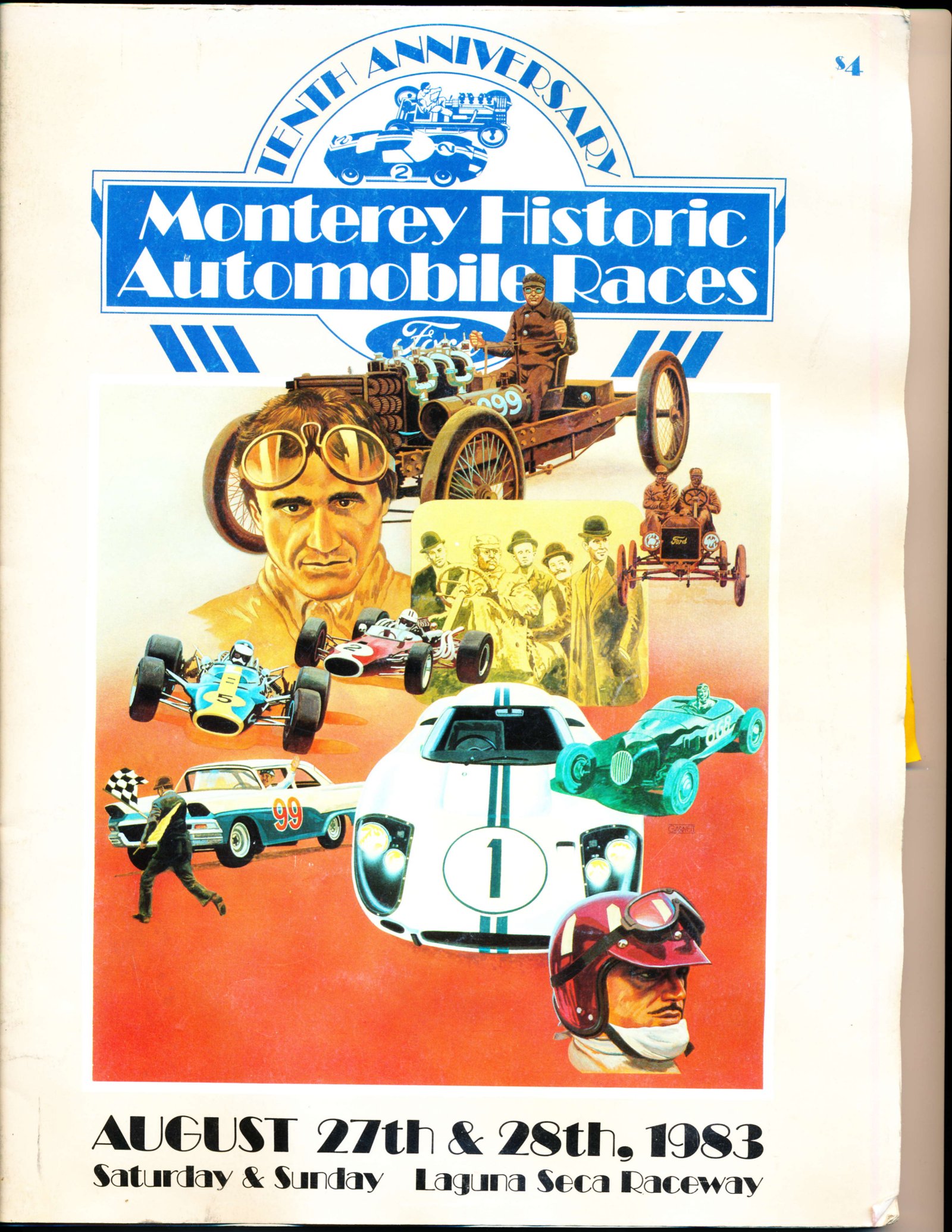
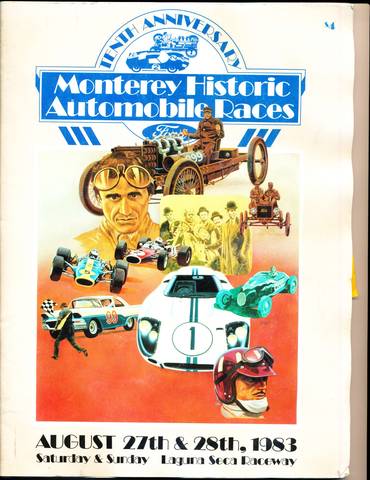
For four dollars, a spectator at Laguna Seca on the last weekend of August 1983 could buy the official program for the Tenth Anniversary Monterey Historic Automobile Races. A copy of that program recently came our way, all 80-odd pages of it, and reading it today is like opening a time capsule from the event we now know as the Rolex Monterey Motorsports Reunion. Here's what it tells us about the races in those days.
It started as a rescue mission. In his welcome letter for the very first event in 1974, founder Steve Earle wrote, "We are slightly overwhelmed with the great turnout of cars for this first event. But just think what this event can become in the future." The goal, as the program puts it, was to see that old racing cars "were not allowed to be destroyed or to decay in moldy barns." That first year, 70 cars took to the track, at least a third of them Ferraris, and the "crowd" was mostly family and friends. By 1983 the entry list had grown to 325.
It was small and friendly. The whole weekend was run by Earle's General Racing Limited with help from the San Francisco Region of the SCCA, and the program lists the whole organizing staff in three lines: a chairman, a staff assistant and one person doing the graphics. The SCRAMP volunteers, in their yellow jackets, ran admissions, parking and concessions, with the money going to local charities. The program says SCRAMP had given away over $2 million since 1957, and it lists the clubs that worked each job: the Lions, the Kiwanis, the Boy Scouts selling ice cream.
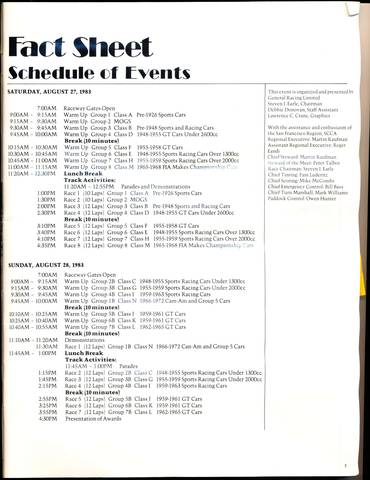
The racing was short and sharp. Each group got a single 15-minute warm-up in the morning and a single race in the afternoon. On Saturday, August 27, the pre-1926 sports cars and the group listed as "MOGS" ran 10 laps; everyone else ran 12. Sunday was the same again for the second set of groups. That was 15 races in two days, with parades and demonstrations at lunch and the awards at 4:30 on Sunday afternoon. The groups ranged from pre-1926 sports cars to the Can-Am and Group 5 cars of 1966 to 1972.
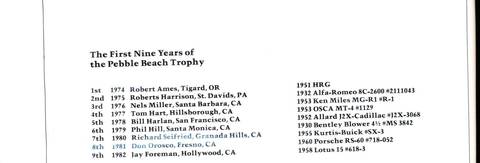
There was only one trophy that really counted. From the start, the organizers decided the only "serious" award would be the Pebble Beach Trophy, for the car judged to have excelled in both performance and appearance. It wasn't enough to be fast, and it wasn't enough to be pretty. The program lists the first nine winners, from Bob Ames' 1951 HRG in 1974 to Jay Foreman's 1958 Lotus 15 in 1982. Phil Hill won it in 1979 in a 1930 Blower Bentley. By 1983 there was a second award too: Sears' Craftsman Division was handing out an etched glass trophy, tools and a tool box for the best new restoration.
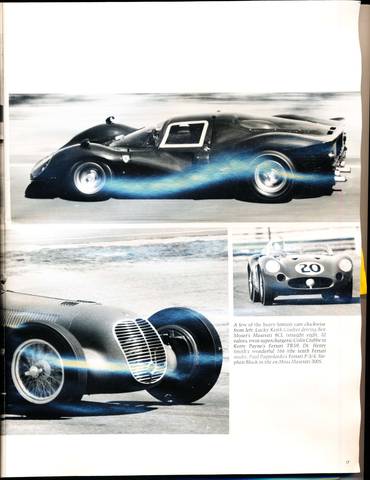
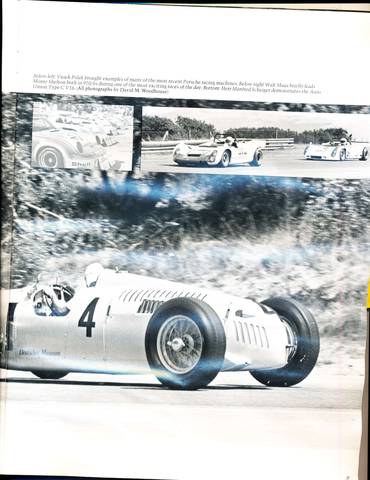
Every year honored one make. The tradition began in 1975 with Alfa Romeo, when Phil Hill won his class in the same Alfa 2900B he'd driven to victory at Pebble Beach in 1951. Then came Jaguar, Bugatti, Mercedes-Benz, Bentley, MG, Briggs Cunningham and, in 1982, Porsche. The program's look back at those years is full of moments we wish we'd seen. Phil Hill threw his "enormous" Blower Bentley sideways through Turn Nine with the relief valve "exploding great clouds of smoke." In 1977 Gordon Gimble's Cobra and Scooter Patrick's Porsche 904 raced nose to tail, swapping the lead all the way to the flag. Then there was Porsche year, 1982. On Friday evening the paddock had gathered for its barbecue when a silver shape came over the Turn One hill: the Auto Union Type C V16, borrowed from the Deutsches Museum in Munich. "No one could believe it," the program says.
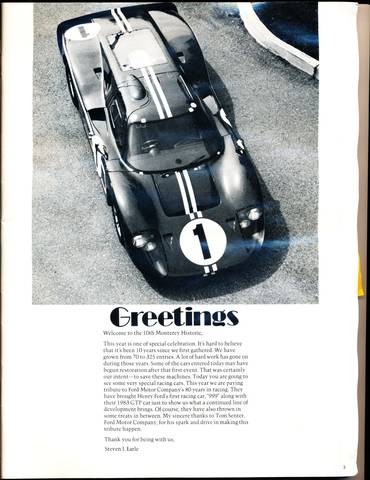
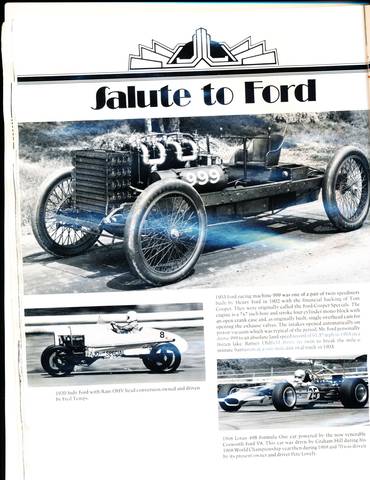
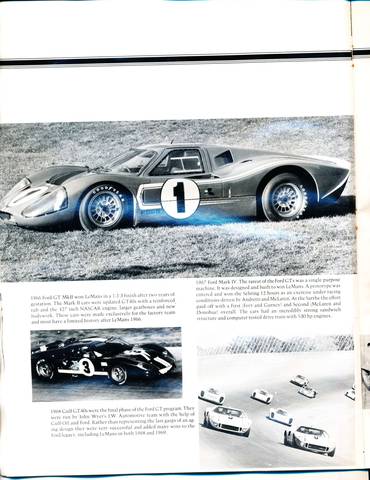
In 1983 the honored make was Ford, celebrating 80 years in racing. Ford brought Henry Ford's first racing car, the 1902 "999," and its brand-new 1983 GTP car, "just to show us what a continued line of development brings," as Steve Earle wrote. In between, the program's "Salute to Ford" pages walk through Ford-powered Indy cars, the GT40s and the Le Mans-winning Mark IV. Two veterans of the 1908 French Grand Prix were there too: George Wingard's Mercedes, the car that won that race, and David Uihlein's Mors.
The racing was real racing. The 1983 program was frank about it: by 1977 "some of the races were getting serious enough to cause some concern for the welfare of both drivers and machinery." But it also describes a paddock where "there is little cliquishness among the participants since saving the cars and having a good time are the prerequisites." Their favorite award from 1982 says a lot about the mood: Porsche's Jürgen Barth was given the "keep plugging" award for having two cars fail under him "for really silly reasons."
The ads are a time capsule too. DieHard batteries from Sears. The British School of Motor Racing, teaching in Formula Fords at Laguna Seca and Riverside. A restaurant in Santa Barbara for the drive home. A full page for the Riverside Historic Automobile Races, October 15 and 16, 1983, at a track that closed in 1989.
Reading the entry list, we kept running into cars and names from our own journal.
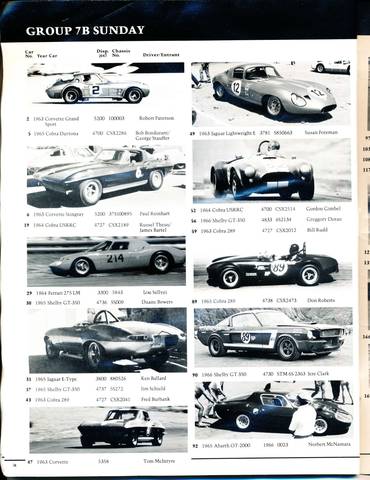
Peter Brock. In our very first post we talked with Peter Brock about his days at General Motors when the Corvette was being designed. In Group 7B on Sunday, for 1962 to 1965 GT cars, the very first entry is a 1963 Corvette Grand Sport, with a 1963 Stingray a few lines down. On the same page: Bob Bondurant entered in Cobra Daytona Coupe CSX2286, the long-tailed coupe whose body Brock designed. The program's Ford section calls it "one of the cars Bob Bondurant drove to the production category World Manufacturers Championship in 1965."
The 356. In our post on three 356s we went looking for the start of the Porsche shape. In 1982 Porsche brought "Project 356 (Porsche Number 1)" from its factory museum, and Chuck Forge's 1949 Gmünd coupe, chassis 356/2-063, which the program calls the "ex-John von Neumann Gmünd Porsche," won the race for 1948 to 1955 sports cars under 2000cc. Forge and the Gmünd were back on the 1983 entry list, alongside 356s from 1953, 1955 and 1962.
Austin-Healeys. Walt Sikes raced his 1955 Austin-Healey 100 this August. Forty-three years earlier, Phil Coombs entered a 1955 Austin-Healey 100-M as car number 100, and the 1982 results list a 1954 and a 1955 Austin-Healey 100/4.
Astons. Our current Saturday series is all about Astons on Ocean Avenue. The 1983 entries include a 1950 DB2, a 1955 DB2/4, two 1955 DB3S racers and a 1959 DB4 GT, and the look back at earlier years mentions Jerry Rosenstock's "rare Aston Martin DB4 Zagato."
Ford. And in a year when Ford was the honored make, the program found room for a 1954 Lincoln Capri that Ray Crawford drove to a stock-class win in the 1954 Carrera Panamericana. It's a long way from our Australian Twin Spinner ute, but it's the same family.
The program closes its look back with a line we like: "Monterey will always be the place for fantasies to come true. See you in the paddock among the fantasies that already have." Forty-three years later, the paddock is still where we find our stories.
Do you have a program, ticket stub or photo from an early Monterey Historic? We'd love to see it. Tell us in the comments.
Photo credits: the race photographs in the program's look back at 1974 to 1982 are by David M. Woodhouse (one, of the Veritas at Turn Nine, by Steve Dawson). All pages are reproduced from the official 1983 program, published by General Racing Limited.
Photos